
01 — Partnership · Exploratory research
NUMU × Titans Space Industries
Under a non-binding Memorandum of Understanding effective 28 May 2026, NUMU is the Bio-Materials and ISRU Composites Partner of Titans Space Industries. The work is research: what grown materials could mean where every kilogram has to be carried.
Agreement
Non-binding MoU
Effective
28 May 2026
NUMU role
Bio-Materials & ISRU Composites Partner
Stage
Exploratory research
The Moon’s terminator, photographed by the Artemis II crew, 6 April 2026. Image: NASA.
02 — Why biological materials matter in space
Every kilogram has to be carried.
Building beyond Earth runs into one constraint before any other: everything that is not found on site must be launched. NASA describes in-situ resource utilization (ISRU) as harnessing local resources at the destination instead of taking every supply from Earth, from propellant and life-support consumables to feedstock for manufacturing and construction.
That is already the logic of NUMU on Earth. The GCC imports most of its synthetic foams and acoustic materials; NUMU grows an alternative from the region’s own agricultural residue. A material that is grown, rather than mined and processed, raises an obvious research question for places where shipping is the limiting factor: could compact inputs be grown into useful volume at the destination?
NUMU is not the first to ask it. NASA Ames has studied mycelium as a building material for the Moon and Mars for several years. The MoU gives NUMU a place to contribute practical knowledge of growing, stabilising and finishing these composites at scale.
03 — Research directions
Six questions we are exploring.
01 · Exploratory
Bio-based composites
Structural and non-structural mycelium composites, and how their density, strength and stability could be tuned for constrained environments.
02 · Exploratory
Growing instead of shipping
Mycelium manufacturing as a way to send compact inputs (spores, dry feedstock) and grow volume at the destination.
03 · Exploratory
Local and recovered feedstocks
Which organic inputs could be available or recoverable in a closed habitat, by analogy with the agricultural residues NUMU uses on Earth.
04 · Exploratory
Fabrication under extreme conditions
What controlled growth requires (water, temperature, sterility, containment) and where those requirements conflict with extreme environments.
05 · Exploratory
Circular material flows
Reuse and end-of-life routes for grown parts, so that a material can return to feedstock instead of becoming waste.
06 · Exploratory
Interfaces with life support
A possible interdisciplinary question: how biological manufacturing might sit alongside closed-loop life-support systems. A research direction, not a deliverable under the MoU.
04 — From Earth to extreme environments
Two surfaces, one question.
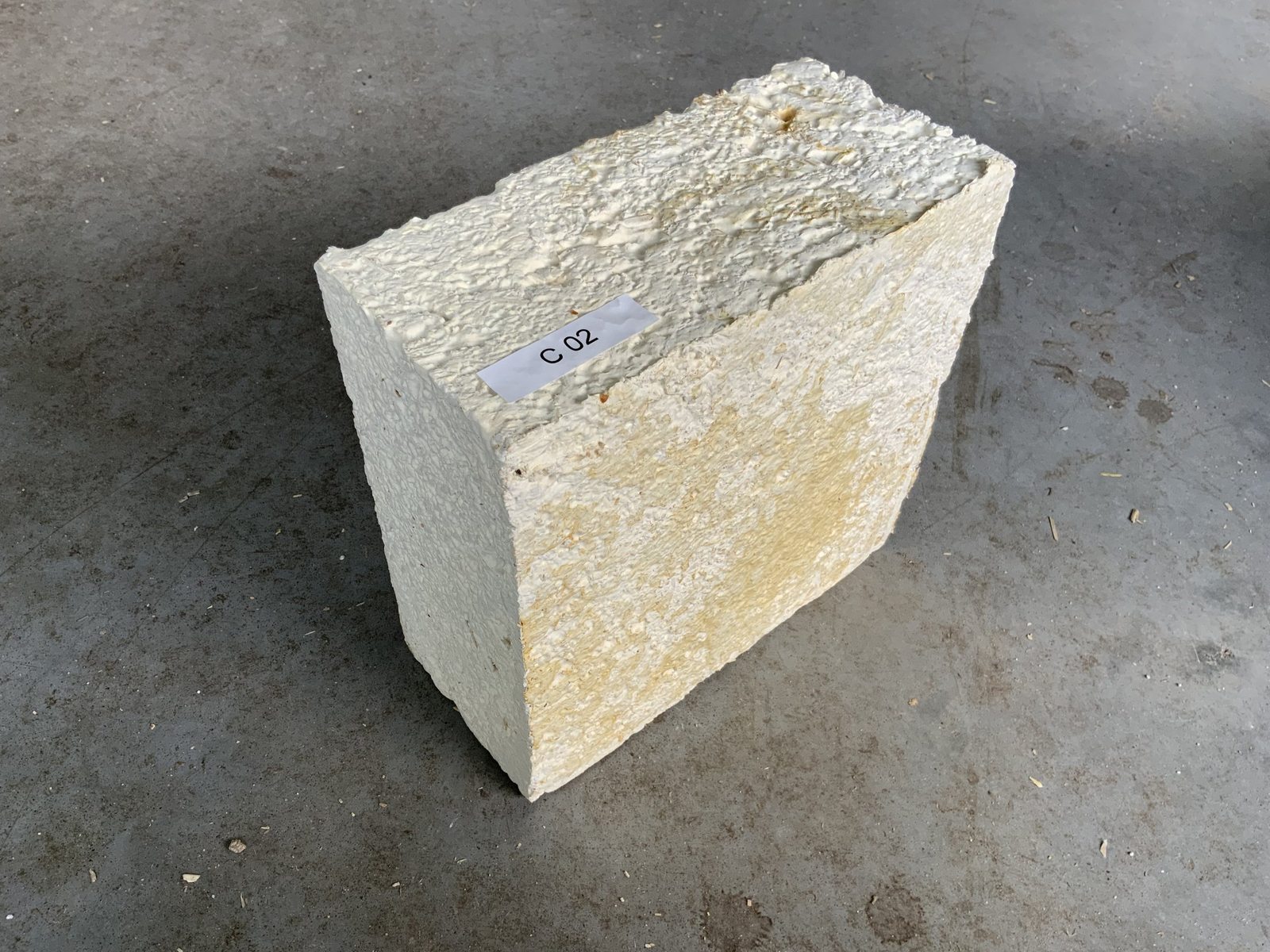

On Earth, NUMU takes an abundant residue, date-palm fibre, and lets a fungal network bind it into a rigid, light composite in a mould. The material is heat-stabilised, so growth stops and the part keeps its shape.
The parallel with extreme environments is conceptual, and so are its limits. Vacuum, radiation, temperature swings, water budgets and biological containment all change what is possible. The value of the research is to map those limits honestly before anyone designs hardware around them.
On Earth · today
- Local feedstock
- Controlled growth
- Stabilised composite
- Use
- Return to feedstock
UAE date-palm fibre, grown and stabilised in the Dubai lab.
Extreme environments · research
- Local feedstock
- Controlled growth
- Stabilised composite
- Use
- Return to feedstock
Which inputs exist, what growth needs, what the part must survive. Open questions.
05 — Partnership framework
A real MoU, exploratory by design.
The MoU took effect on 28 May 2026. It establishes a non-binding framework of strategic alignment between NUMU Biotech FZCO and Lachman Capital Partners LLC on behalf of Titans Space Industries, and positions NUMU as the bio-materials and ISRU composites partner within TSI’s Space & Lunar Economy Consortium.
It sets a basis for future discussion of research, payload experimentation, technical roadmaps and partnership visibility. It does not commit either party to a programme, a budget or a flight.
What NUMU contributes
- Growing and stabilising mycelium composites at production scale
- Feedstock selection from agricultural residue
- Material samples and documented process knowledge
What this is not
- No NUMU material has been tested in space
- No flight-qualified or certified spacecraft components
- No life-support hardware is developed under the MoU

About Titans Space Industries
Spaceplanes and Earth–Moon infrastructure.
Titans Space Industries is an Orlando-based company developing reusable spaceplanes and orbital and lunar infrastructure, led by founder and CEO Neal S. Lachman. Its Space & Lunar Economy Consortium brings together companies and institutions across the space value chain.
Learn more at titansspace.com.
06 — Research & perspectives
Further reading.
A short, curated list. The first group is published by Titans Space Industries; the second gives independent context on ISRU and mycelium for space. These are external publications: NUMU is not an author, and inclusion does not imply endorsement either way.
From Titans Space Industries
Neal S. Lachman, Franklin Ratliff, Marcus Beaufort · Titans Space Industries · 4 April 2024
Forging a New Frontier: Titans Space Launches the Space & Lunar Economy Consortium
The founding note for the consortium NUMU joined, and the range of disciplines TSI set out to bring together, from supply chain and manufacturing to research institutions.
(opens an external site)Neal S. Lachman · Titans Space Industries · 7 April 2024
Moon Made: Unveiling the Advantages of Space Manufacturing on a Lunar Base
TSI’s case for manufacturing on the Moon from lunar resources rather than delivering every input from Earth.
(opens an external site)Neal S. Lachman, Franklin Ratliff · Titans Space Industries · 28 May 2024
Sustainable Lunar Energy: Integrating Solar Power Farms and Lunar Thermal Wadis
A white paper on storing heat in modified regolith to carry settlements through the lunar night: an example of in-situ resources doing structural and thermal work.
(opens an external site)Neal S. Lachman · titansspace.com · Treatise, manifesto and modular blueprint
Earth-Moon Economic, Infrastructure, and Civilizational Architecture
TSI’s long-form framework for Earth–Moon infrastructure, settlement and commercialisation, with a public preview.
(opens an external site)
Independent context
NASA Ames Research Center · 14 January 2020
Could Future Homes on the Moon and Mars Be Made of Fungi?
NASA’s myco-architecture project and the idea of growing structures at the destination from fungi and dried feedstock.
(opens an external site)NASA Innovative Advanced Concepts (NIAC) · 26 June 2024
Mycotecture off Planet: En Route to the Moon and Mars
The continuing NASA study of fungal mycelium composites as an off-planet building material.
(opens an external site)NASA · Programme overview
In-Situ Resource Utilization (ISRU)
NASA’s definition of ISRU and its focus areas, including feedstock for manufacturing and construction.
(opens an external site)
07 — Research collaboration
Working on materials for constrained environments?
Universities, agencies and companies researching bio-based materials, ISRU or closed-loop systems can contact NUMU about samples, data exchange and joint work.